
Hamden Court Records After a Jail Arrest
Every Hamden arrest follows the same broad path before a court record exists. Police take someone into custody. Officers book the person, log the arrest, and note bond and custody status. The case then moves to a prosecutor. In Connecticut the prosecutor is called a State's Attorney, not a district attorney. The State's Attorney files or proceeds on the charges. That filing opens a Superior Court case. From that point on, the court record is the official account of the charges and the case.
The arrest side and the court side answer different questions. Booking and custody detail belong to the jail. To find where someone is held or read what a custody record shows, use the jail inmate records page, and for booking-photo rules see the jail mugshots page. The court record is separate. It holds the charges the State's Attorney actually filed, the bond the judge set, the court dates, and the result. Those filed charges can differ from the offense listed at booking, which is why the court file matters after an arrest.
Which Court Hears Hamden Cases
Hamden has no court of its own. After a Hamden arrest, the case lands in one of two Superior Court tracks based on how serious the charge is. Connecticut splits adult criminal work into Part A and Part B. Part B covers lower-level adult crimes and motor-vehicle offenses. Part A covers the most serious felonies. Each track sits in a different building, so the court record lives where the case was filed.
Lower-level Hamden cases go to Geographical Area court GA 7 in Meriden, at 54 West Main Street. GA 7 handles Class C, D, and E felonies, misdemeanors, infractions, and motor-vehicle offenses for Cheshire, Hamden, Meriden, North Haven, and Wallingford. A Geographical Area court, or GA, is the local Superior Court that hears most everyday criminal matters. Serious Part A cases route to the New Haven Judicial District court at 235 Church Street in New Haven, which takes Class A and Class B felonies. New Haven also runs GA 23 at 121 Elm Street. The New Haven Judicial District town list names Hamden, so a Hamden case can show up at any of these locations depending on the charge.
Note: a Judicial District, or JD, is the larger Superior Court that hears the most serious felonies and major civil matters, while a GA handles the bulk of routine criminal cases.
How to Find Hamden Court Records After an Arrest
Connecticut court records after an arrest are free to look up online. The Connecticut Judicial Branch criminal and motor-vehicle case lookup is the portal. It does not show booking photos or live custody status. It shows the case the prosecutor filed: the charges, the docket number, the court location, the bond, and the events on the case. Arrest and booking detail stays with the jail and the police, not the case lookup.
The Judicial Branch case lookup portal is the starting point for any Hamden case search.
Here is how to find the case after an arrest.
- Open the Judicial Branch criminal and motor-vehicle case lookup at jud.ct.gov/crim.htm.
- Choose the pending case search by defendant, or use the docket number if you already have one.
- Open the matching case and read the full charge list.
- Check each charge for its code, its level, and its current status.
For a Hamden defendant, set the court location filter to Meriden GA 7 for lower-level cases, or to the New Haven Judicial District for serious felonies. If the case has closed and ended in a conviction, switch to the conviction search by defendant. The case lookup is a public service, not the official court record, so the Judicial Branch warns that you should confirm anything important against the file at the court of record.
Search Pending Criminal Cases by Defendant
When you do not have a docket number, the pending search by defendant is the way in. You enter a name and a few narrowing details, then pick the court. The search covers open criminal and motor-vehicle matters across Connecticut, so the court-location field is what ties the result to a Hamden case. Try Meriden GA 7 first for most Hamden arrests, then the New Haven Judicial District for serious charges.
The pending criminal case search uses these fields.
| Field | Required | Notes |
|---|---|---|
| Last Name begins with | Yes | Defendant last-name prefix. |
| First Initial | No | One letter to narrow the list. |
| Birth Year | No | Year of birth. |
| Year Range +/- | No | Widens or tightens the birth-year match. |
| Court Location | No | Includes Meriden GA 7, New Haven GA 23, and the New Haven JD. |
| Category Type | Yes | Criminal, Motor Vehicle, or a referred motor-vehicle license matter. |
A common last name pulls a long list, so the first initial and birth year matter. The result row links to the case, where the charge list and court dates appear.
Search Hamden Court Records by Docket Number
A docket number is the case ID the court assigns. If you have it from a bond paper, a court notice, or an attorney, the docket-number search is the fastest route. The number has a few parts, and you enter each one. The court-location code is the part that points at the right building, so the right code is what links the search to a Hamden case.
The docket-number search uses these fields.
| Field | Required | Notes |
|---|---|---|
| GA / JD code | Yes | N07M for Meriden GA 7, N23N for New Haven GA 23, NNH for the New Haven JD. |
| Type | Yes | CR criminal, MV motor vehicle, CI, or MI. |
| Year | Yes | Docket year. |
| Number | Yes | Numeric docket sequence. |
| Suffix | No | S, T, A, or 0 through 9 where used. |
If the docket pulls nothing, double-check the court code. A Hamden case filed in Meriden will not appear under a New Haven code. You can also browse by court location if you only know the building.
Why Jail Charges and Court Charges Differ
The offense at booking is not the last word. The DOC custody record or the police arrest may list a controlling offense or a bond status. The court record shows the charges the State's Attorney actually filed, plus the events on the case. Prosecutors hold real discretion here. They may decline a charge, amend it, reduce it, substitute a different one, nolle it, or dismiss it. So the charge a reader sees on the court file can differ from what showed at the jail.
A few status terms come up again and again on a Connecticut court record.
| Status | What It Means |
|---|---|
| Pending | The case is open and moving through court. No final result yet. |
| Amended / Reduced | The prosecutor changed a charge, often to a lower level. |
| Dismissed | The charge is dropped and the case ends on that count. |
| Nolle | Short for nolle prosequi. The prosecutor chooses not to pursue the charge for now; under state law it can lead to erasure after the set period. |
Because of this gap, the court file is the better source for the real charges after an arrest. The jail record tells you about custody and bond. The court record tells you what the State is actually prosecuting.
Note: a nolle is not the same as an acquittal, and the case can be reopened within the statutory window before erasure applies.
Which Prosecutor Handles the Case
Connecticut does not use district attorneys. It uses State's Attorneys, and which office runs a Hamden case depends on the charge level. The split mirrors the Part A and Part B court tracks. Serious felonies go to the Judicial District office. Routine cases go to the Geographical Area office. Knowing which one holds the file helps when you need a person to call about the case.
You can confirm the office and court for a New Haven-area case on the State's Attorney page.
The Division of Criminal Justice lists the offices and courts that serve Hamden cases on its New Haven State's Attorney locations page.
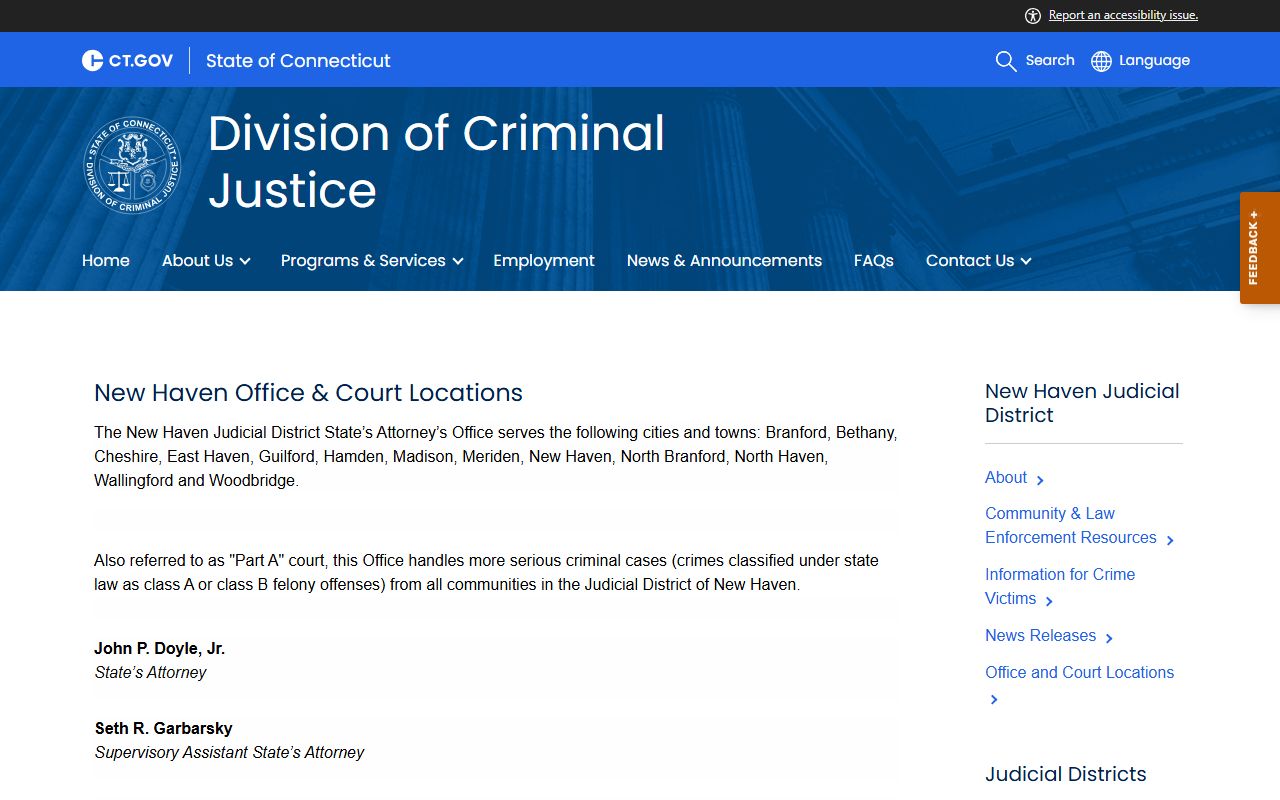
That page confirms the Part A and Part B contacts below, including the Meriden office that handles most Hamden cases.
Office of the State's Attorney, Judicial District of New Haven
Part A serious felonies (State's Attorney John P. Doyle, Jr.)
235 Church Street
New Haven, CT 06510
203-503-6823
State's Attorney's Office, GA 7 Meriden
Part B Hamden cases (Supervisory Assistant State's Attorney John Lion)
54 West Main Street
Meriden, CT 06451
203-238-6125
How Charges Get Filed After an Arrest
The charge record begins when the prosecutor files, not when police make the arrest. Connecticut does not run ordinary cases through grand jury indictments the way some states do. Instead the State's Attorney files an information, or proceeds on the charges, and the case opens in Superior Court. Booking happens first at the police or DOC level. The formal court charges follow when the prosecutor acts. The table below shows how the two main tracks compare for a Hamden case.
| Part B (GA 7 Meriden) | Part A (New Haven JD) | |
|---|---|---|
| Charge Level | Class C, D, E felonies; misdemeanors; infractions; motor vehicle | Class A and Class B felonies |
| Where Filed | 54 West Main Street, Meriden | 235 Church Street, New Haven |
| Prosecutor | Supervisory ASA John Lion | State's Attorney John P. Doyle, Jr. |
| Docket Code | N07M | NNH |
Most Hamden arrests run through the Part B track at Meriden. The serious cases move to New Haven. Either way, the public court record opens once the prosecutor files, and that is what the case lookup pulls up.
Bond, First Appearance, and Clerk Records
Bond decisions start at the arrest and continue at the first court appearance. Connecticut law lets police and a bail commissioner or intake assessment specialist set release terms right after an arrest. A person may be released on a written promise to appear, on nonfinancial conditions, on a bond without surety, or on a bond with surety. If a police officer cannot reach an available bail commissioner, the officer may order release on a written promise to appear or set a bond. Pretrial Services can later interview the person and raise or lower the police-set bond.
The common bond types break down like this.
| Bond Type | How It Works |
|---|---|
| Written promise to appear | Release with no money posted, on a promise to come to court. |
| Nonfinancial conditions | Terms such as no contact or travel limits, often for victim protection. |
| Bond without surety | A bond obligation with no surety backing it. |
| Surety bond | A bail bondsperson posts the bond for a fee that is not refundable. |
| Cash bond | The full amount paid to the clerk; returned only after the case closes. |
| Real estate bond | Real property put up as security after the court sets bail. |
Bail may be posted at the police department where the person is held, at a courthouse, or at the DOC facility holding the person. Since January 1, 2020, a 10 percent cash option is automatically available for bonds of $20,000 or less, subject to listed exceptions. To get a cash bond back, the case must be disposed or the person must be in a diversionary program. The clerk needs the original receipt, or an Affidavit of Lost Bond Receipt with a photo ID, and the clerk issues a check rather than cash. The New Haven GA 23 clerk's office sits at 121 Elm Street and is open Monday through Friday, 9 a.m. to 5 p.m., reachable at 203-789-7461.
Note: a hold, detainer, warrant, parole issue, or federal matter can keep someone in custody even after one bond is posted.
Charges vs. Convictions in Court Records
An arrest and a charge are not a conviction. A charge is an accusation that rests on probable cause. A conviction comes from a guilty plea or a verdict, proven beyond a reasonable doubt. The court record shows both, but it treats them differently, and the conviction search has limits the pending search does not.
| Charge | Conviction | |
|---|---|---|
| Stage | Accusation after arrest | Guilty plea or verdict |
| Proof Needed | Probable cause | Beyond a reasonable doubt |
| Where to Search | Pending case search | Conviction search by defendant |
| How Long Shown | While the case is open | Up to 10 years after sentencing |
The conviction search by defendant shows each charge that led to a conviction in the last 10 years, unless a Practice Book rule sets a shorter window. Youthful offender cases, juvenile cases, infractions, and violation convictions do not appear there.
The conviction search by defendant is the tool for closed cases that ended in a finding of guilt.
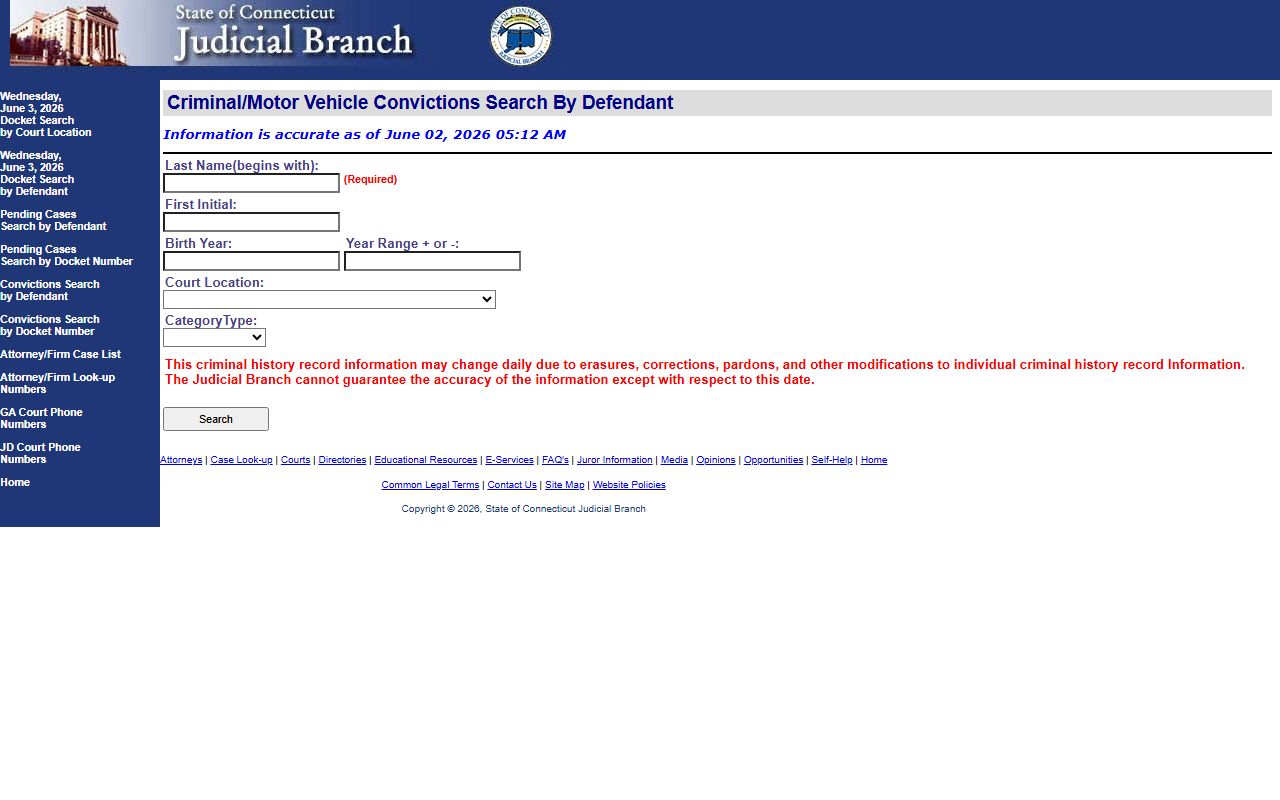
Because criminal history can change daily from erasures, corrections, and pardons, a name that showed yesterday may not show today.
Warrants That Lead to a Hamden Arrest
Many arrests start with a warrant. An arrest warrant is a court order to take a person into custody on an alleged offense. A bench warrant usually follows a missed court date or a violated court order. Hamden has no public online warrant search, and the Town pages list no public most-wanted page. The Police Department keeps warrant, protective-order, and restraining-order files in its Communications Division. Those files are available to dispatchers and sworn officers around the clock, but they are for officer confirmation, not public lookup.
If you think a warrant may exist, there are sound channels and one clear caution. Call the Hamden Police Department at 203-230-4000, or speak with an attorney. If the warrant has already become a court event, the pending case search or the docket-number search may show it. For a formal record search, a written request goes to the Geographical Area court where the arrest happened, which for most Hamden matters is Meriden GA 7. Many warrants never appear as public web records, so confirmation can require law-enforcement or court channels. No one should simply walk into a station when an active warrant may exist without first talking to a lawyer, the court, or the issuing agency.
What the Court Case Lookup Shows
The Judicial Branch case lookup pulls together what the court has on file for a case. It shows the charges, the docket number, the court location, the bond, and the scheduled events. It does not show a mugshot or a live cell location. For that custody side, the jail roster and the DOC locator are the right tools, and the case lookup links across the criminal and motor-vehicle dockets statewide.
The portal divides into a pending search, a conviction search, a search by court, and a docket-number search.
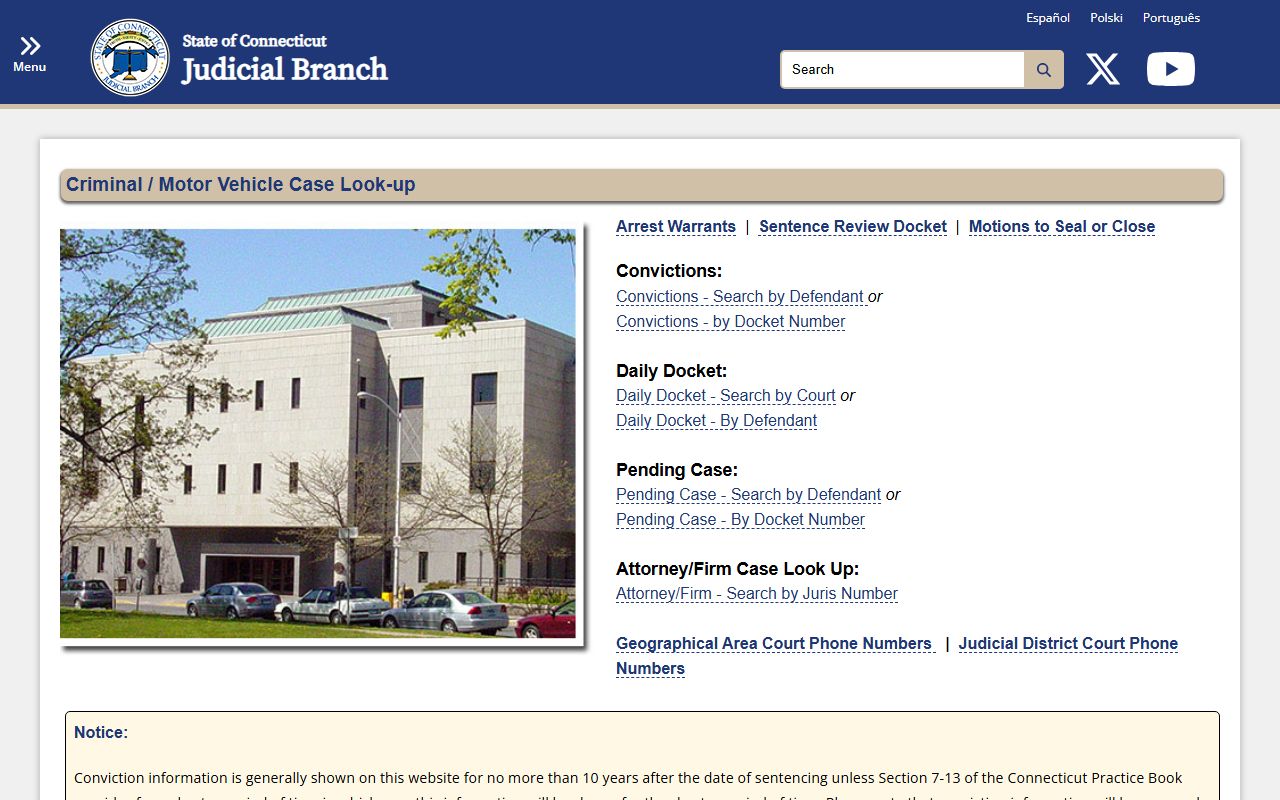
From that one page you can reach every search a Hamden case needs after an arrest.
What you see is shaped by access rules. The court records FAQ explains that criminal files are generally open unless sealed. Convictions are open. Nonconvictions follow disclosure guidelines. The case lookup disclaimer stresses that the online data is a public service and not the official court record, so you confirm it against the court of record. The pending search itself displays the live defendant view.
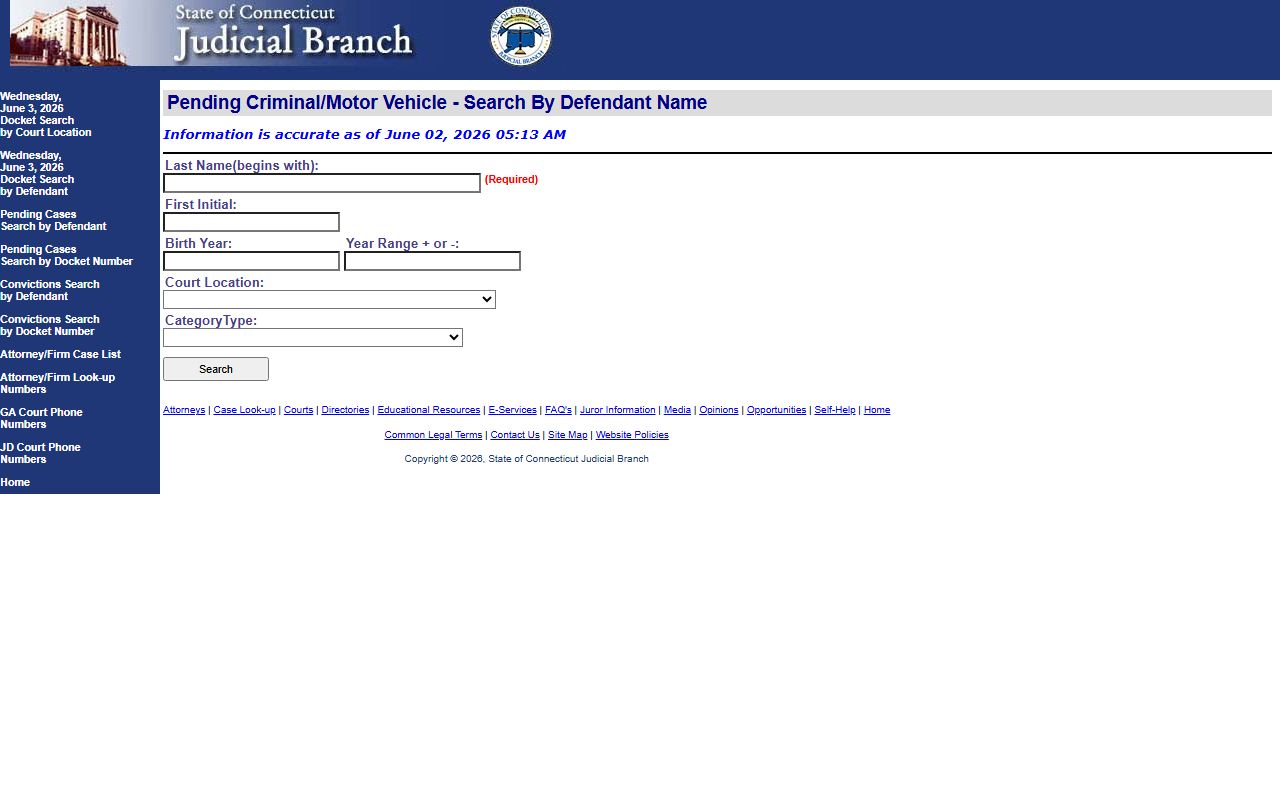
That defendant search is the one most people use to find a Hamden case right after an arrest.
Court Records That Disappear After Erasure
Connecticut does not use the word expungement for criminal records. It uses erasure. Under CGS 54-142a, qualifying records are erased after outcomes like a dismissal, a nolle that ages out, an acquittal, or a pardon. Once a record is erased, the clerk may not disclose anything about the case, and in some situations may not even acknowledge that it ever existed. So the right comparison here is public versus erased, not sealed versus expunged.
| Public / Open | Erased | |
|---|---|---|
| Who Can See It | Anyone, through the case lookup | Restricted; clerk may not confirm it |
| Typical Outcome | Conviction, or a pending case | Dismissal, aged nolle, acquittal, pardon |
| Timing | Open while the case lives | Dismissals stay 20 days, then are sealed |
A dismissal is available for 20 days after disposition, unless appealed. After that, under CGS 54-142a and related sections, the clerk may not disclose anything about the case. A nolle is erased after its statutory period runs. For mass purchasers of records, CGS 54-142e requires that erased matters be updated or deleted within set timing, which is why old third-party copies sometimes linger. The erasure statutes in Chapter 961a hold the exact rules.
Note: because erasure can wipe access overnight, a case you found last month may be gone from the public record today.
Requesting Older or Official Court Files
The online case lookup is convenient, but it is not the official record. When you need the certified file, an old closed case, or a document the portal does not display, you make a written record search to the court. The request goes to the Geographical Area court where the arrest happened, which for most Hamden cases is Meriden GA 7. Include the person's name and date of birth, and the date of arrest or disposition if you have it. Each search covers only that one court location.
Copy charges are set by the Judicial Branch. Court records and documents cost $1.00 per page. Administrative records cost $0.25 per page. The New Haven GA 23 clerk's office at 121 Elm Street is open Monday through Friday, 9 a.m. to 5 p.m., at 203-789-7461, and the GA 23 public guide walks through the building, the clerk functions, and the bail process. The New Haven Judicial District town list confirms which court covers Hamden and at which address.
Background Checks and Statewide Records
People sometimes treat a court case lookup like a full background check. It is not. The Division of Criminal Justice does not provide public criminal records, and its criminal records page routes people to the State Police, the Judicial Branch, and the Department of Correction instead. A complete check pulls from several systems, and the access rules in the Connecticut FOIA statutes govern what each agency may release.
Important. Hamden Inmate Population is not a consumer reporting agency under the FCRA, and nothing here may be used for employment, tenant, credit, or insurance screening.
Victim Notification and Case Updates
People close to a case often want updates without checking the court site every day. Connecticut offers notification tools for that. VINELink, the state's CT SAVIN system, lets a registered user get alerts about custody and case status. A DOC profile also prompts CT SAVIN registration. Sign up at VINELink Connecticut to receive custody and court notifications.
The Judicial Branch publishes a victim notification brochure that explains the available services and how to register. Court clerks and the State's Attorney's office can also point a victim to the right contact. These tools track the case after an arrest so a notice arrives when a court date or a custody status changes, rather than relying on a manual record check.